Cat straining to pee with little or no urine? Go to a vet now
If your cat is straining in the litter box and passing little or no urine, take it to a vet now, day or night. This is especially urgent in male cats, whose narrower urethra can become blocked. Cornell Feline Health Center calls urethral obstruction an absolute emergency: without treatment a fully blocked cat can die in less than 24 to 48 hours.
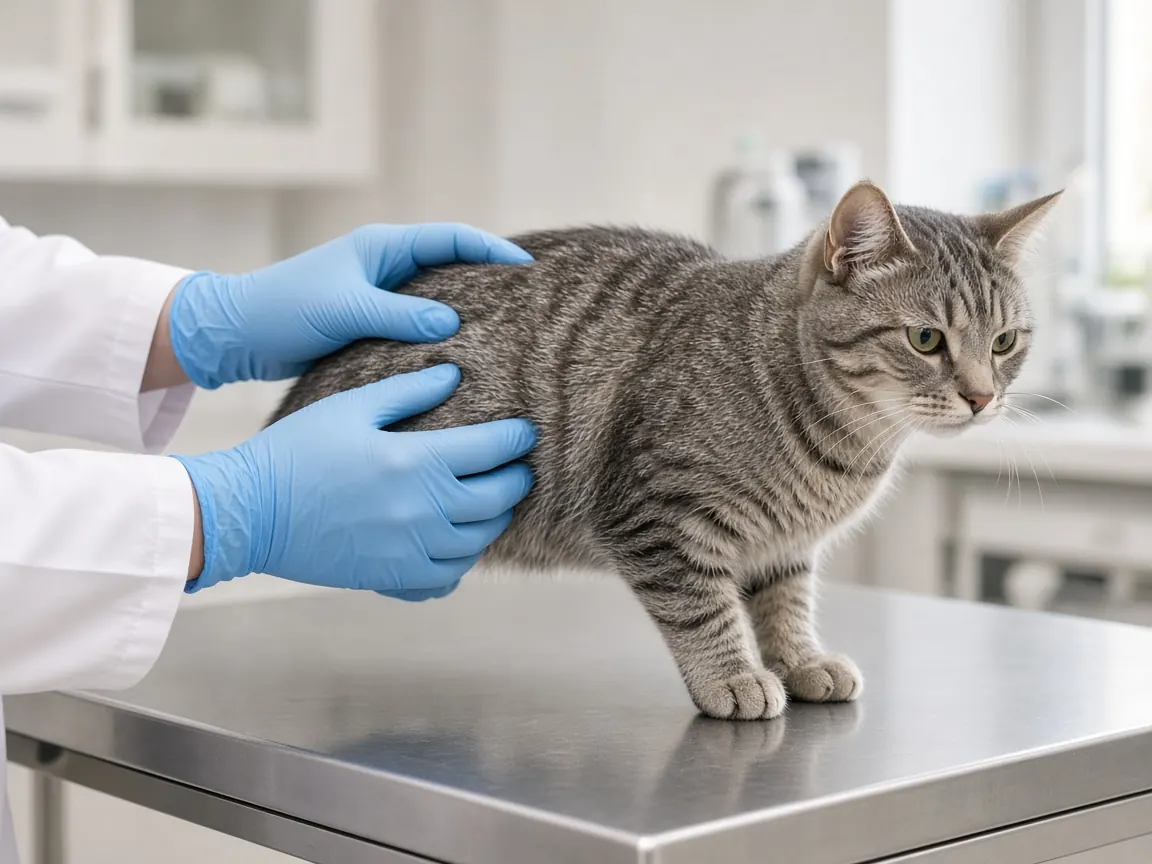
Emergency checklist
Go to the nearest open vet immediately if your cat:
- squats or strains repeatedly and produces only drops or nothing
- cries out or seems in pain when trying to pee, or licks its genital area constantly
- keeps going in and out of the litter box
- is male and has any of the above, even if it seems otherwise well
- is also vomiting, very quiet, hiding or not eating
Call ahead if you can so the clinic is ready. Do not wait overnight to see if it passes.
Why straining to pee is so serious
Straining, frequent attempts and small amounts of urine are signs of lower urinary tract disease (often shortened to FLUTD or LUTS). Most cats with these signs have inflammation of the bladder or urethra, and some have stones or infections. Those cats are uncomfortable and need a vet, but they are still passing urine.
The danger is urethral obstruction: a blockage of the tube that carries urine out of the body. When it is completely blocked, urine cannot leave, and the kidneys can no longer clear toxins or keep the body's fluids and electrolytes in balance. Cornell explains that the cat's condition then deteriorates rapidly and it can develop life threatening electrolyte imbalances, with death possible in less than 24 to 48 hours. The same warning signs are on the emergency list.
A blocked cat often looks, at first, like a cat with ordinary cystitis: straining, frequent trips, little urine. The difference is that a blocked cat becomes more and more distressed, often crying out in pain. Because you cannot tell the two apart at home, treat any cat straining with little or no urine as blocked until a vet says otherwise. The 2025 iCatCare consensus guidelines, by Samantha Taylor and colleagues in the Journal of Feline Medicine and Surgery, make the clinic version of that point: the same lower urinary tract signs can come from different diseases, so the cause has to be investigated, and urethral obstruction is a life threatening complication.
Why male cats are at higher risk
Male and neutered male cats are much more likely to block than females because their urethra is longer and narrower. Blockages are commonly caused by urethral plugs, a soft material made of minerals, cells and mucus like protein, or by small stones. Cornell notes that lower urinary tract disease is most often seen in middle aged, overweight cats that get little exercise, use an indoor litter box, have restricted outdoor access and drink less water, and that stress, such as living with several cats or moving home, can increase the risk. Weight and feeding sit on the nutrition guide. Drinking less is a risk Cornell names, and how cats drink is a separate question from whether the bowl is easy to use.
Straining to pee or constipation?
Owners often mistake a blocked bladder for constipation, because both involve straining in the box. You cannot reliably tell them apart at home, and the cost of guessing wrong with a blocked bladder is very high. If you are not certain your cat is producing normal clumps of urine, see a vet the same day.
What happens at the vet
The vet will feel the bladder; a blocked bladder is usually large, firm and painful. Blood tests check potassium and kidney values, which can become dangerous quickly. Cornell says treatment usually means sedating or anesthetizing the cat to pass a urinary catheter, then intravenous fluids for dehydration and electrolyte imbalance. Hospitalization can last from a few days to several weeks, depending on how bad the blockage was and how long it had gone on. The vet will then look for the underlying cause, such as idiopathic cystitis, stones or infection.
After a blockage: lowering the risk
Cornell's page, which says it was updated in October 2016 and which we re-read on 20 November 2026, is more specific than "it will happen again." Of cats with lower urinary tract signs, Cornell says most rarely have the problem again, or have it only now and then, while a few have frequent recurrences of bladder inflammation, another obstruction, or stones. Follow the vet's plan closely either way. If obstruction keeps returning despite that care, Cornell describes a surgery called perineal urethrostomy, which removes the narrow end of the urethra, as a last resort because it can be followed by bleeding, narrowing at the surgery site, urinary incontinence and a greater chance of other bladder disease. That choice is the vet's to explain, not a home treatment. Common parts of a home plan include:
- More water: more wet food, several water bowls or a fountain, as your vet advises.
- Any prescribed urinary diet, fed exactly as directed.
- Less stress: enough litter boxes in quiet places (see how many litter boxes), predictable routines, play and hiding spots.
- Healthy weight and exercise.
- Know your cat's normal: in a multi cat home, it can be hard to tell who is peeing. Watch any cat with a history of blockage closely.
Sources checked 20 November 2026: Cornell Feline Health Center, Feline Lower Urinary Tract Disease (page says updated October 2016; the 24 to 48 hour line and the hospitalization range are still on it) and the abstract of Taylor and colleagues, 2025 iCatCare consensus guidelines (PubMed 39935081).
Straining to pee FAQ
Is a cat straining to pee an emergency?
If the cat is producing little or no urine, yes, especially if it is male. Cornell Feline Health Center describes urethral obstruction as an absolute emergency that can be fatal in less than 24 to 48 hours.
How long can a cat go without peeing?
A completely blocked cat can die in less than 24 to 48 hours, according to Cornell. Do not wait to see if a straining cat passes urine; see a vet immediately.
Why are male cats more likely to get blocked?
Male cats have a longer, narrower urethra, so urethral plugs and small stones are more likely to lodge in it.
Can a urinary blockage clear on its own?
Do not rely on it. Even if a blocked cat passes some urine, the underlying problem remains and the cat can re-block. Any cat that has been straining with little or no urine needs a vet check.
Sources
- Cornell Feline Health Center: Feline Lower Urinary Tract Disease
- Cornell University Hospital for Animals: Emergency and Critical Care (emergent conditions)
- Taylor S. et al., iCatCare Veterinary Society (2025) 2025 iCatCare consensus guidelines on the diagnosis and management of lower urinary tract diseases in cats. J Feline Med Surg
- AAHA/AAFP 2021 Feline Life Stage Guidelines: General litter box considerations
Cite this page
Students and teachers are welcome to cite this page. Add your access date if your teacher or style guide asks for one.
APA (7th ed.)
MeowWise. (2026, November 20). Cat straining to pee with little or no urine? Go to a vet now. https://meowwise.com/blog/cat-straining-to-pee.html
MLA (9th ed.)
“Cat straining to pee with little or no urine? Go to a vet now.” MeowWise, 20 Nov. 2026, meowwise.com/blog/cat-straining-to-pee.html.
Chicago (bibliography)
MeowWise. “Cat straining to pee with little or no urine? Go to a vet now.” Last modified November 20, 2026. https://meowwise.com/blog/cat-straining-to-pee.html.
General education, not veterinary advice. If you are worried about your cat, contact your veterinarian; in an emergency, go to the nearest emergency vet.